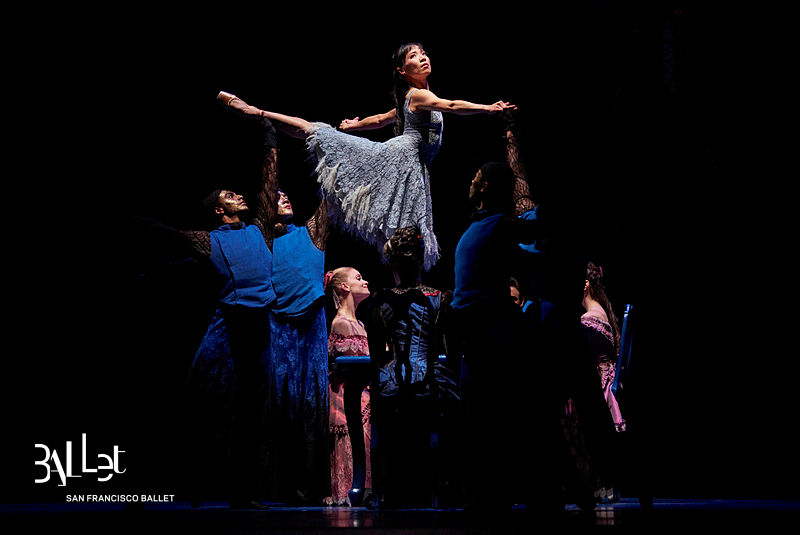
SAN FRANCISCO BALLET - CINDERELLA
A Modern Twist.
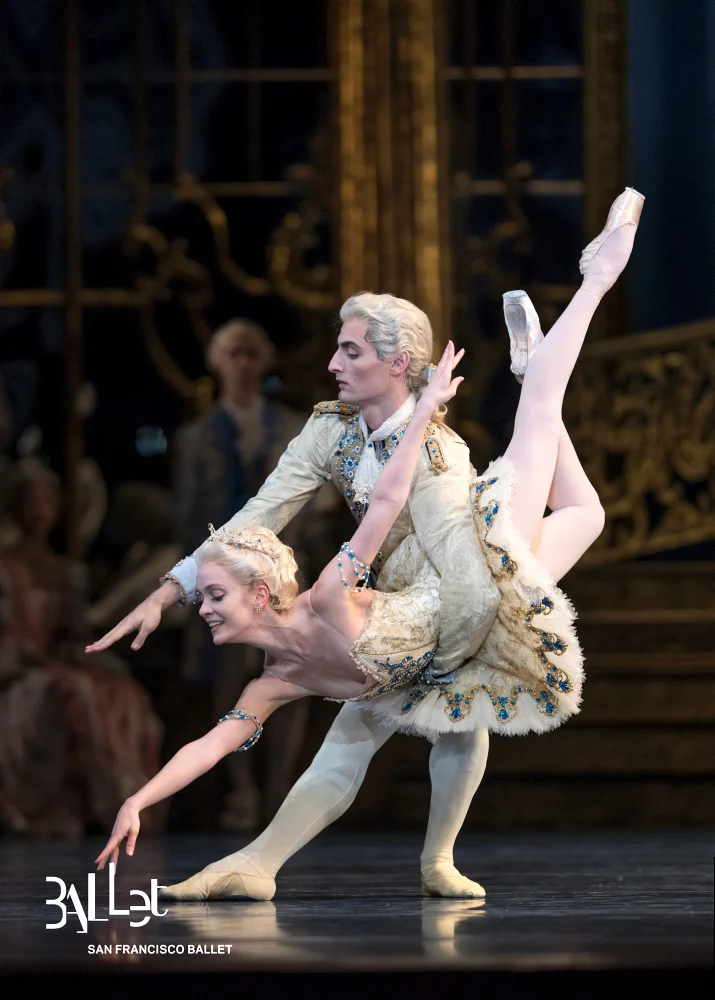
The heart of the old, the spirit of the new. Christopher Wheeldon's Cinderella tells the same uplifting story people have heard for centuries, but this is a ballet full of innovations and modern twists. A co-production of San Francisco Ballet and Dutch National Ballet, Cinderella premiered in Amsterdam in 2012, then flew across the Atlantic to make its US premiere in San Francisco in 2013.
Frances Chung and Joseph Walsh in Wheeldon's Cinderella©.
(© Erik Tomasson)
"Each of Christopher's works has something unique," says Helgi Tomasson, SF Ballet's artistic director and principal choreographer. Wheeldon is an acclaimed dancemaker, in demand at companies worldwide.
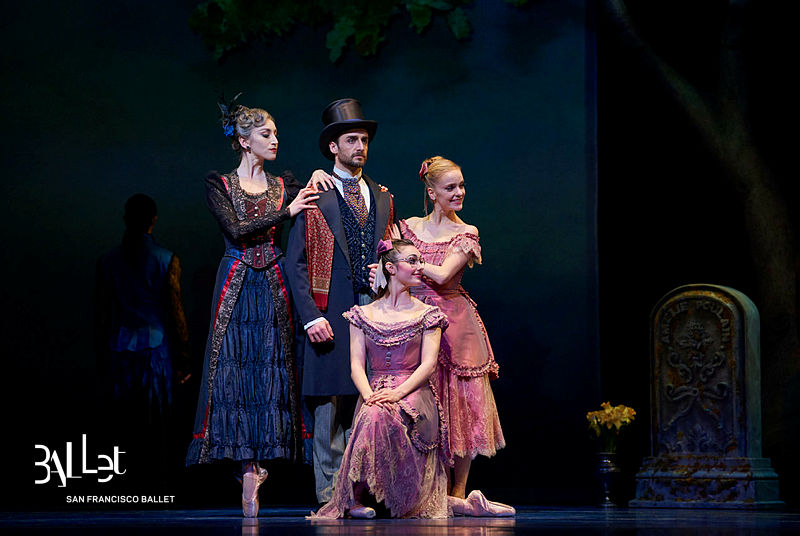
Windeldon's Cinderella is all about originality. You'll find no fairy godmother, no pumpkin coach, no clock stricking midnight - but you won't miss them a bit when a tree comes alive and "dances", or when Cinderella shows backbone and her Prince's charm runs deep. And you won't miss them when the dancing and the storytelling comes from Christopher Wheeldon. "What I wanted to do," the choreographer says, "was echo the darkness in the music by taking some of the themes from the Brothers Grimm version rather than the {Charles} Perrault version," with its fairy godmother and pumpkin coach. " The Grimm version is more serious and a bit darker, centered around nature and the spirit of mother." That's where he got the idea of a tree that grows from the grave of Cinderella's mother, "the deliverer of all things magic, which I think is more poetic {than a fairy godmother}and quite beautiful," he says. "There are ocmic moments because there's comedy written into the music, but ti's a more serious Cinderella in a way."

San Francisco Ballet in Wheeldon's Cinderella©.
(© Erik Tomasson)
Music, written by Russian composer Sergei Prokofiev in 1940 but shelved for several years during World War ||, made its first appearance when Bolshoi Ballet premiered Cinderella in November 1945, choreographed by Rostislav Zakharov. "I love it," says Music Director and Principal Conductor Martin West about the score. "It's immediately striking, and astonishingly clever the way the themes come around, the way he could create an atmosphere out of something very simple."
But what's a story without a setting? Wheeldon chose Julian Crouch to do the sets and costumes because of his "very fantastical approach to design. He always seems to embrace the darker side of the fairy tales he's done," he says. "It needs to be fluid. It moves scene to scene more rapidly; it has more locations. So fo rme it's been an exercise in suggestion, really - I've had to suggest a location and spport the atmosphere and then move fluidly to the next one." As for the costumes, he says there's "a looseness about them. Fairly tales are 'once upon a time,' not 'once upon 1870.'" The period is the 180s "but spread over the century," he says. " Each character is allowed to drift a bit in time. I'd say it's timeless; in that sense it has a fluidity as well."
This Cinderella is for adults, not children. Christopher Wheeldon's first narrative ballet for SFB takes not only the fairy out, but just about everything else that a fairy tale entails. It's a bit difficult to follow his narration. Why do those mystic creatures appear at the tree in the cemetery? Why does Cinderella need dancing lessons from the Seasons when she did just fine with the beggar/prince? Why does the more evil of the sisters get away scot-free? The production which include the magically growing tree, the dancing chandeliers and flying chairs are still impressive, spectacular in fact. But what you want to see is choreography that looks fresh and tells its story.


San Francisco Ballet in Wheeldon's Cinderella©. (© Erik Tomasson)
San Francisco Ballet, Program 4: Christopher Wheeldon's "Cinderella," through 2 p.m. March 23. $40-$340. War Memorial Opera House, 301 Van Ness Ave., S.F. (415) 865-2000. www.sfballet.org.
Text: Olga Belkina Images courtesy San Francisco Ballet




Onegin
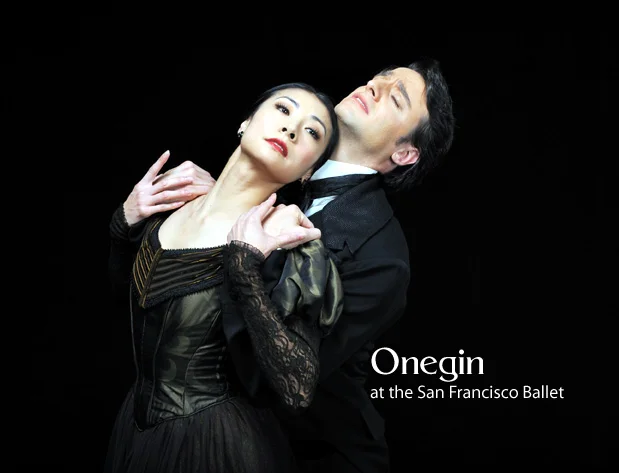
A novel in verse written by Alexander Pushkin on stage at San Francisco Ballet's production of Eugene Onegin.
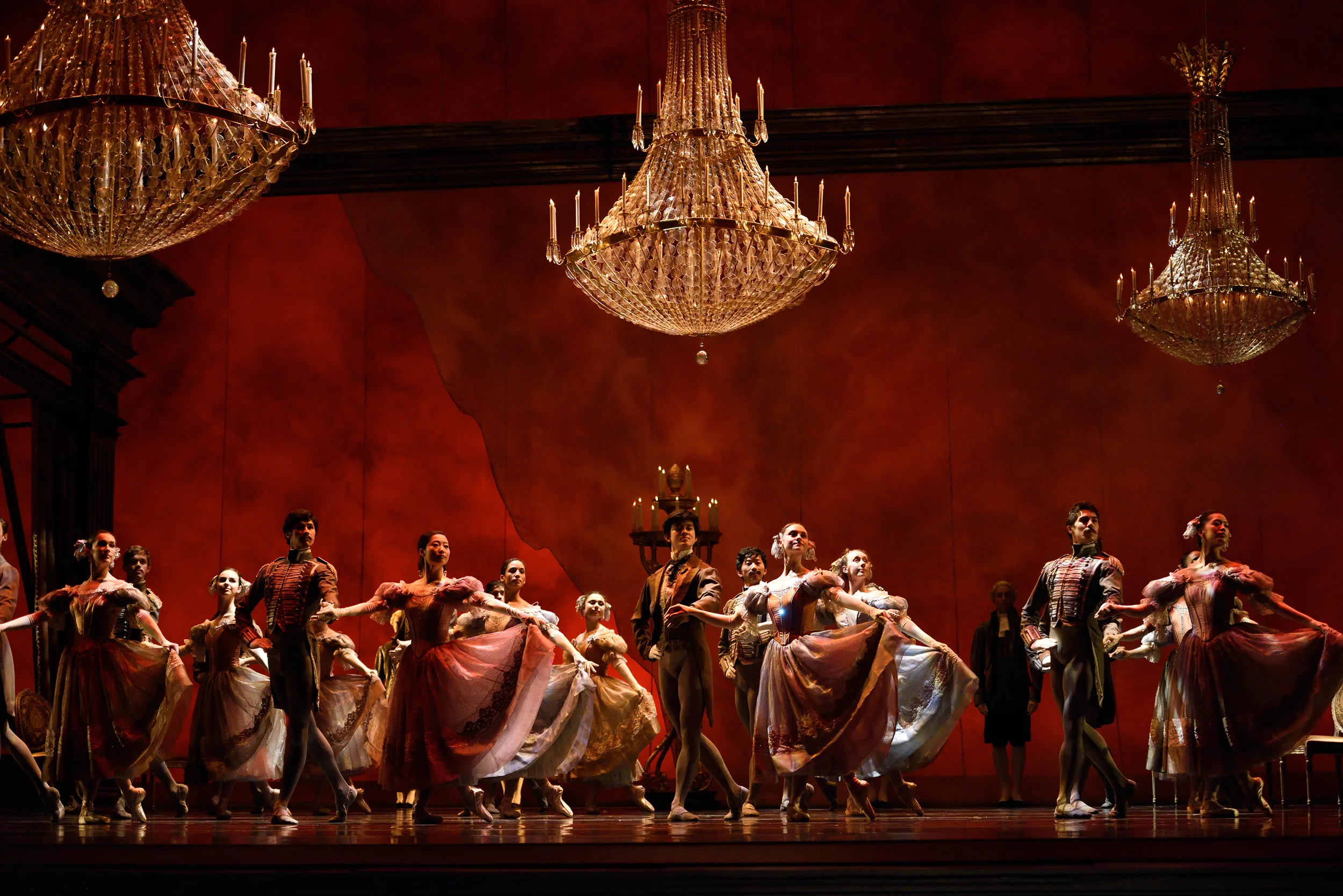
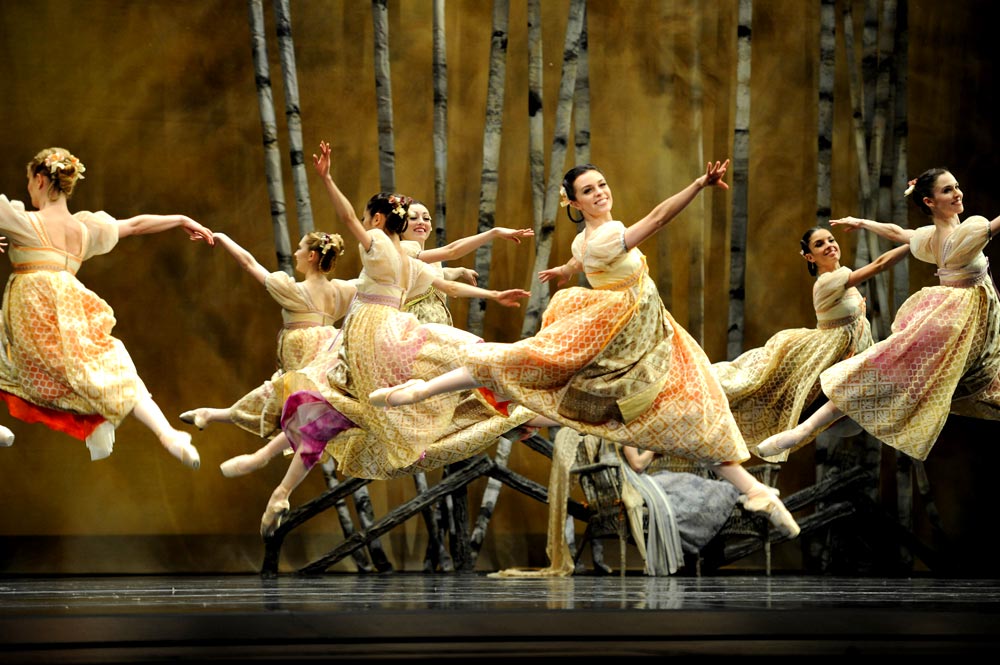
A novel in verse written by Alexander Pushkin - a classic of Russian literature, romantic, psychological story of love and betrayal, tragedy and drama closes San Francisco Ballet season with Eugene Onegin in a magnificent setting. The new stage and costume design by Santo Loquasto, inspired by Russian culture, corresponded perfectly to the time when the poem was born to great Alexander Sergeyevich Pushkin (the founder of the Russian literature). Details such as Tatiana's letter written on the stage curtain, birch trees in the background and Russian tea kettle, known as Samovar set on the table, are just a few to mention.
Luke Ingham danced the part of Eugene Onegin with Shanghai born, principal dancer with San Francisco Ballet, Yuan Yuan Tan dancing the part of Tatiana.
The creativity of Yuan Yuan Tan left us speechless. Delicate, feminine, flexible, truly a professional in the world of ballet. Her artistry and skill has left an indelible mark.
So fragile, slender, yet stately, elegant, distinctive and strong-willed in the dance, Yuan Yuan Tan delivered most complicated elements and combinations of ballet so perfectly.
Luke and Yuan managed to convey to viewers the core of famous poem, characteristics of the main characters, taking us back in the age and years when the poem was written. True professionalism of classical ballet.
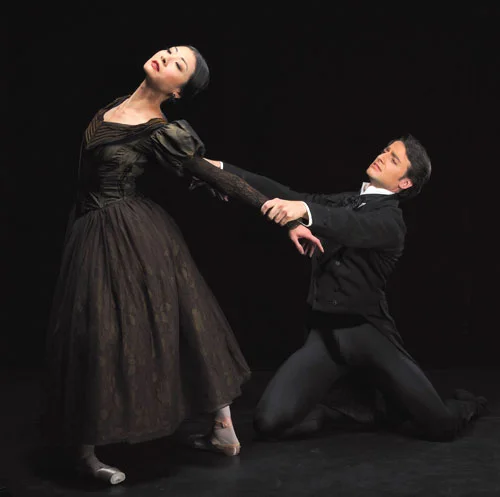
John Cranko ballet from 1965 has not been much performed in the States and made its premiere in San Francisco in 2012. Onegin had been on SF Ballet Artistic Director and Principal Choreographer Helgi Tomasson's wish list for quiet a while.
“It’s one of those dramatic story ballets that are very good for the Company members to experience and be challenged by, especially some who have been with me for a while”
The ballet's orchestra, under Martin West performed music by Tchaikovsky brilliantly.
The corps de ballet multiple jetés diagonally across the stage excited the audience, triggering a round of applause. After 45 years of the premiere of Onegin, Cranko's masterpiece still has the power to astonish the audience. Helgi Tomasson's choreography left the audience looking forward to next season. Now this is the Ballet!
Text JULIET BELKIN
Photos courtesy San Francisco Ballet
.

San Francisco Ballet 2016 delightful production of "Coppélia"

The classic 19th century comic ballet "Coppélia" maybe old, but this tale of a beautiful doll coming to life is as delightful as ever. San Francisco Ballet and its artistic director Helgi Tomasson pleased the crowd with production of "Coppélia". Last night's final performance was truly delightful.
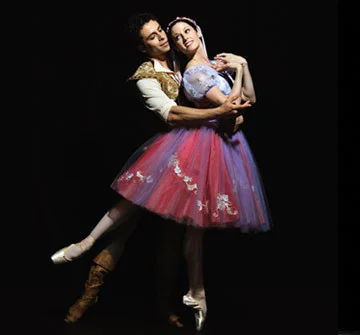
The set, by Judith Fugate, is lavish, ideally setting the scene of a village in Eastern Europe. Mischievous Swanilda danced by charming Vanessa Zahorian opened up the first Act embodying the character completely. Franz, danced by Taras Domitro played the role with the right level of arrogance and cheek. His light as a feather jumps and its height was quiet a thrill to the eye. Leo Delibes's music conducted by Ming Luke illustrated every action so perfectly and created an atmosphere. The choreography all combine to make this a quirky, sweet and memorable show.
Act 2 set revealed the mysterious and dark interior of Dr Coppélius' house perfectly reflecting his state of mind. Behind the velvet curtain sits Coppelia. The Act comes alive when Swanilda and her friends sneak into Coppélius's house. The entrance of dancers in one line, on toes, in tutus and the excitement when Coppélius's dolls come alive make the scene so charmingly amusing.
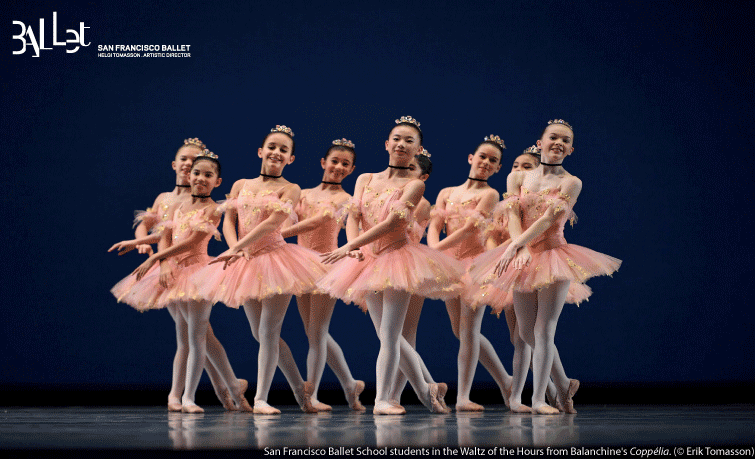
The highlights of Act 3 is undeniably Dedication of the Bells, Waltz of the Golden Hours dancing by San Francisco Ballet students. Dozens of little girls in pink tutus and tiara's displayed a darling and brilliant performance.
Vanessa Zahorian, Taras Domitros, Ruben Martin Cintas, who played mysterious Dr. Coppelius and the entire cast made this performance a memorable one. The darkstory was delivered with such humor and love.
Truly wonderful addition to San Francisco Ballet repertoire.







Vivamus pellentesque vitae neque at vestibulum. Donec efficitur mollis dui vel pharetra.