Ed Hardy: Deeper than Skin
.

(Courtesy of the Fine Arts Museums of San Francisco)
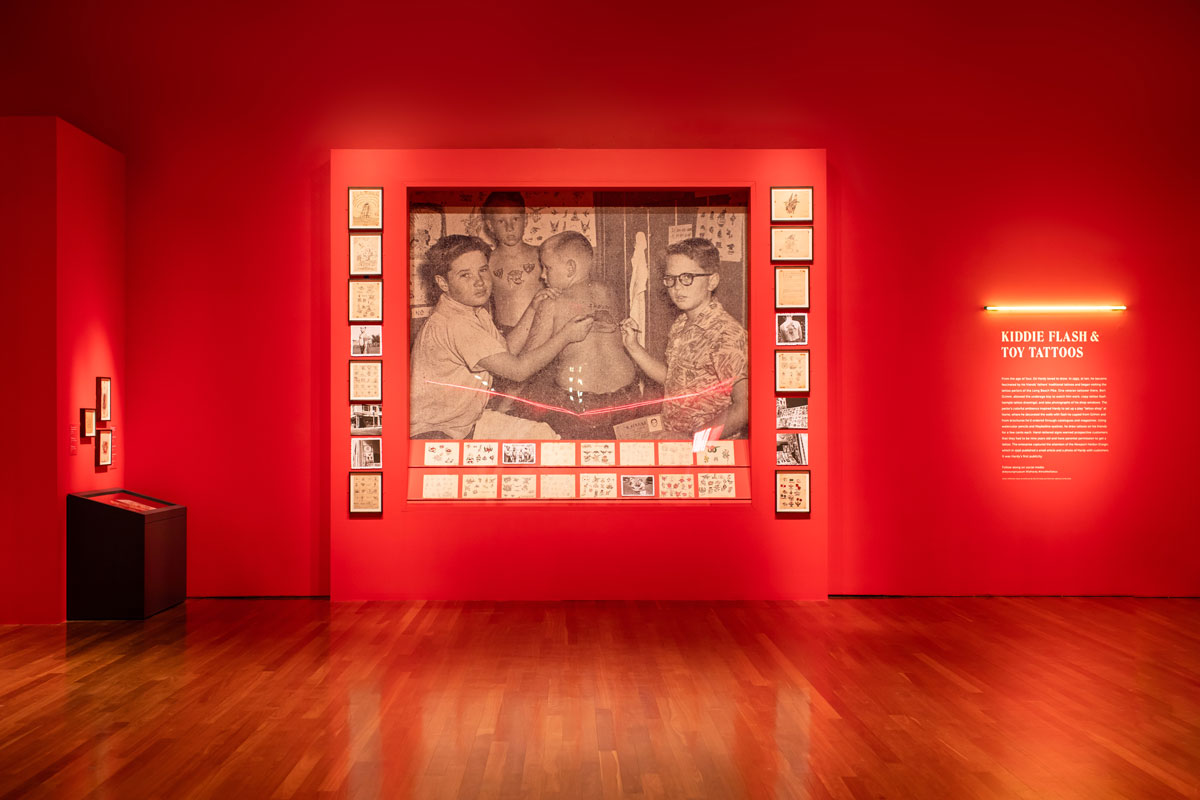
Ed Hardy: Deeper than Skin is the first museum retrospective of Ed Hardy, the renowned tattoo artist known for fueling the late 20th-century boom in the practice of tattoo. Featuring more than 300 objects ranging from paintings and sketches (including drawings Hardy created as a 10-year-old) to prints and three- dimensional works, the exhibition tracks the evolution of tattooing from its “outsider” status through Hardy’s work and influence.
Growing up in Southern California, Hardy was fascinated by the tattoos that he observed on the fathers of his neighborhood friends (mostly servicemen who had served in World War II). During this time Hardy haunted the tattoo parlors on Long Beach Pike, where he learned to draw tattoo designs for his “kiddie tattoo shop.” As a printmaking student at the San Francisco Art Institute in the mid-1960s, Hardy began to study the intricacies of prints by artists such as Dürer, Rembrandt, and Goya at the Legion of Honor’s Achenbach Foundation for the Graphic Arts, the department responsible for the Fine Arts Museums’ collection of more than 115,000 works on paper. At the Achenbach he mined for inspiration for his own work. In 1966, while getting one of his first tattoos from the legendary Phil Sparrow in Oakland, Hardy was introduced to a book on Japanese tattooing, which reignited his love for the medium and inspired his future career. Turning down a graduate fellowship in fine arts from Yale University, Hardy instead decided to begin tattooing professionally.

(Courtesy of the Fine Arts Museums of San Francisco)
“Ed Hardy reinvented the very nature of the tattoo, inspired in large part by his early exposure to the masterworks in our collection,” says Thomas P. Campbell, Director and CEO of the Fine Arts Museums of San Francisco. “His impact has transformed the tattoo industry and we are delighted to provide the opportunity for wider audiences to explore his tremendous achievement both on and off the body.”
(Courtesy of the Fine Arts Museums of San Francisco)
In 1974 Hardy opened Realistic Tattoo in San Francisco, which became the first tattoo studio in the United States to offer custom tattoos based on clients’ wishes and needs.
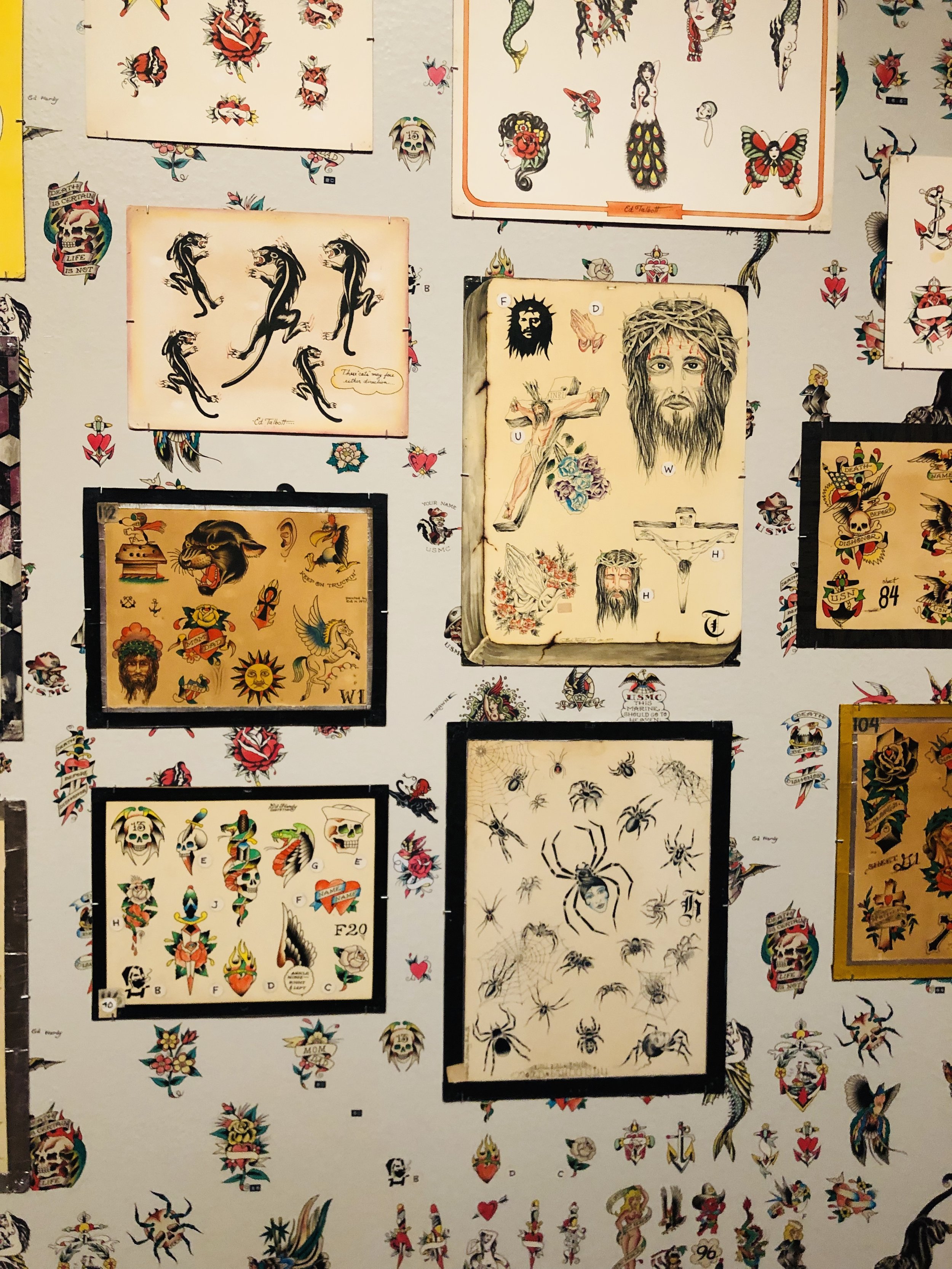
Ed Hardy On view through October 6, 2019
Visiting \ de Young
Golden Gate Park, 50 Hagiwara Tea Garden Drive, San Francisco. Open 9:30 am–5:15 pm Tuesdays–Sundays. Open select holidays; closed most Mondays.











ANDY WARHOL: THE 1950s
FROM A TO B AND BACK AGAIN
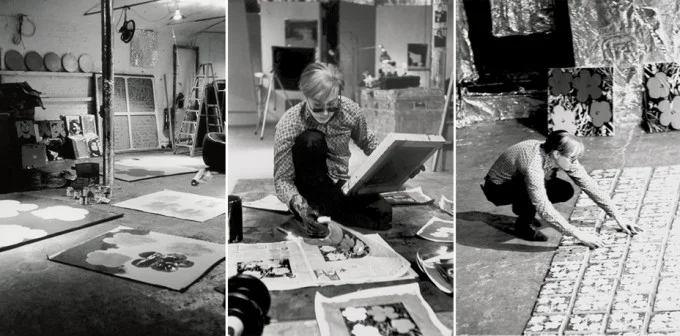
The San Francisco Museum of Modern Art (SFMOMA) opens the exclusive West Coast presentation of the critically acclaimed exhibition, Andy Warhol—From A to B and Back Again on Saturday, May 19. The exhibition will run through September 2, 2019. Spanning the artist’s 40-year career and featuring more than 300 works on three different floors of the museum, the exhibition includes paintings, drawings, graphics, photographs, films, television shows as well as a personal time capsule of ephemera. The retrospective features examples of the artist’s most iconic pieces in addition to lesser-known abstract paintings from later in his career. Uncannily relevant in today’s image-driven world, Andy Warhol—From A to B and Back Again provides new insight into Andy Warhol himself by examining the complexities of this enigmatic artist more than 30 years after his death in 1987. The show’s title is taken from Warhol’s 1975 book, The Philosophy of Andy Warhol (From A to B and Back Again), a memoir featuring the artist’s musings on fame, love, beauty, class, money and other key themes that frequently appear in his work.

“He’s a complicated figure and a complicated artist,” said Gary Garrels, Elise S. Haas Senior Curator of Painting and Sculpture at SFMOMA. “His inner emotions, his psychic self were not his subject matter. Warhol is constantly labeled a Pop artist, but all that happened within three or four years and then he moved on and the work goes quite dark and explores questions of gender and sexual identity, fame, subcultures. At the time of his death, the consensus was that Warhol was no longer relevant. But the last major retrospective in 1989 was a wake-up call: this is an artist we have to reckon with.”
THE EXHIBITION
Andy Warhol—From A to B and Back Again is presented on three floors of SFMOMA: two, four and five.
On the museum’s second floor, two galleries of works on paper offer a detailed look at Warhol’s earliest drawings from the 1940s and hand-drawn commercial illustrations created for advertising in the 1950s. These early drawings lay the groundwork for many of the techniques and approaches he would use throughout his career. This portion of the exhibition includes delicate, gilded collages and sketches of shoes for the I. Miller Shoe Company, and illustrations for publications such as Glamour Magazine and The New York Times, as well as personal, little known drawings, often with homoerotic subjects.
On fourth-floor of SFMOMA special exhibition galleries, the exhibition takes visitors chronologically through the arc of Warhol’s career and his production in painting, drawing, photography, film and installation. The first half of the exhibition opens with his best known work from the creatively active period of 1960–68, with his earliest paintings such as Dick Tracy (1961) and Superman (1961), followed by the groundbreaking, iconic Pop Art paintings, Green Coca-Cola Bottles (1962), 192 One Dollar Bills (1962) and the sculpture, Brillo Boxes (1969, version of 1964 original). The exhibition then highlights Warhol’s depictions of celebrities, including Elvis, Elizabeth Taylor and Jacqueline Kennedy. In a dedicated black box gallery adjacent to the early Pop Art work, samples of Warhol’s films and videos are on view including his series of Screen Tests featuring Ethel Scull, Edie Sedgwick and Billy Name (1964–65).

Subjects take a darker turn in Warhol’s Death and Disaster paintings (1963–64) memorializing car crashes, the electric chair and a benign yet sinister can of tuna fish contaminated with botulism. An eye-popping gallery filled with 16 colorful Flower paintings (1964) will be installed on top of Warhol’s Cow Wallpaper (1966) for a bold immersive experience. Visitors will have a chance to experience Silver Clouds, Warhol’s sculptural installation of shiny Mylar balloons created in 1966, the point at which he declared himself to be done with painting.

Warhol’s work of the 1970s and 1980s focuses on post-Pop artwork, which Garrels observes are “very unknown to most people.” In these galleries Warhol shifts his focus with a massive portrait of Chairman Mao (1972), followed by a gallery featuring photographs and paintings of trans women and drag queens from the 1970s, which provide a look into Warhol’s fascination with the elusiveness and complexity of gender and identity. A separate suite of photographic self-portraits of Warhol in drag provides a different view into the artist’s carefully cultivated persona. A large single gallery is dedicated to Warhol’s grand experiments with abstract painting, featuring a gold Shadow painting (1978) and two large-scale Rorschach paintings (1984). Warhol’s influence on the young artists of the East Village in the 1980s is highlighted through collaborative works created with Jean-Michel Basquiat and Keith Haring. Also on display is an unpacked personal time capsule, one of 610 created over the course of the artist’s life.
A gallery in the museum’s fifth floor Pop, Minimal and Figurative Art presentation feature a 1970s “facebook” of wall-to-wall grids of large-scale silk-screened portraits representing a “who’s who” of celebrities, cultural icons, gallerists, athletes and business leaders from the late 1960s to the mid- 1980s. This gallery features over 40 portraits such as Halston (1975), Dominique de Menil (1969), Liza Minnelli (1978), Pelé (1977), Leo Castelli (1975), Nan Kempner (1973), Gianni Versace (1979–80), Robert Mapplethorpe (1983 ) and Dolly Parton (1985), as well as the artist’s mother, Julia Warhola (1974). For the subject, a Warhol portrait provided social validation and an immediate status symbol; for Warhol these commissions were a consistent revenue stream that supported his studio and desire to explore other more personal ventures. Warhol’s television shows and videos are on display in the adjacent city gallery on this floor.
May 19 through September 2, 2019: Open Sunday–Tuesday and Friday 10 a.m.–5 p.m., Thursday and Saturday 10 a.m.–9 p.m. Closed Wednesday. sfmoma.org/groups






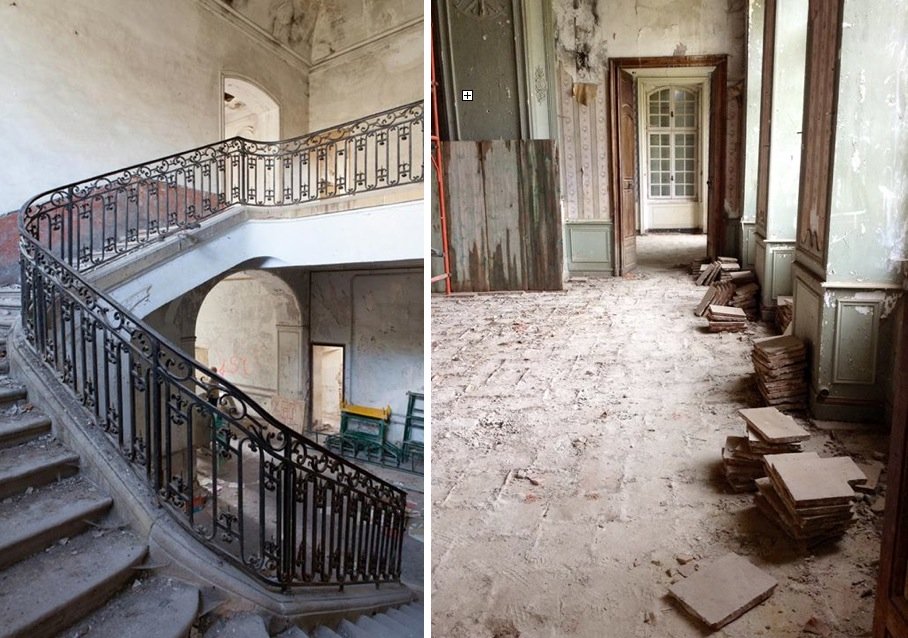

Jasper Conran buys Yves Saint Laurent's Villa Mabrouka in Tangier
Yves Saint Laurent’s home in the last decades of his life
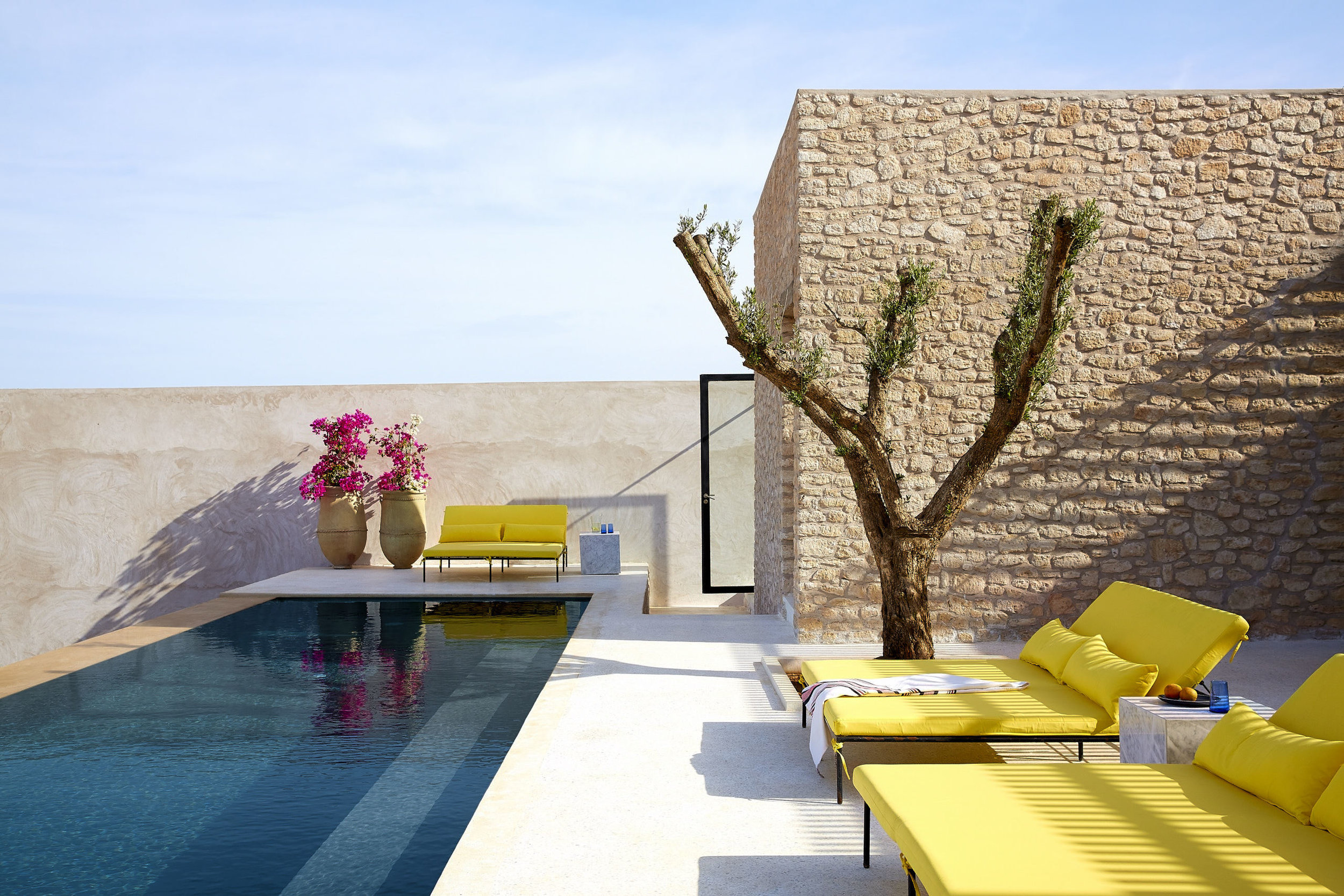
Villa Mabrouka, Tangier © Sotheby's
The British fashion and interiors designer Jasper Conran is set to purchase Villa Mabrouka in Tangier from the Fondation Jardin Majorelle in Marrakech, Morocco for an undisclosed price. The foundation which was founded by Yves Saint Laurent and Pierre Bergé.

Villa Mabrouka, Tangier © Sotheby's
Bergé's instructions prior to his death in September 2017 were that all proceeds from the property's sale will go towards the not-for-profit Fondation Jardin Marjorelle. The sale's announcement was made by Bergé's heir, AD100 landscape designer Madison Cox, who wed Bergé shortly before his death and is president of Fondation Jardin Majorelle and the Fondation Pierre Bergé-Yves Saint Laurent in Paris.







A New Museum Emerges From The Sand. A New Voice For Qatar and Its People.
Celebrities and large fashion crowd gets together for the opening of The National Museum of Qatar.
Celebrities gather for The National Museum of Qatar opening in Doha, Qatar. Among many are Johnny Depp, Zac Posen, Olivier Rousteing, Naomi Campbell, Natalia Vodiyanova, Victoria Beckham and more.
Museum was designed by Jean Nouvel, the Pritzker Prize-winning French architect. The multifaceted structure resembling a giant desert rose sits across from the bustling Doha Corniche, the main waterfront promenade in the Qatari capital.
The futuristic, sand-coloured structure, located near Doha's airport highway, is likely to be among the first buildings visitors will spot when arriving in the city.
Desert Rose
The museum is designed as a free-form space, in a way that does not include doors, and is meant to offer visitors a fluid experience as they move through time, space and themes. The building is a symbol of Qatar's culture and tradition.

Must-see installations and exhibitions at the Venice Art Biennale 2017
The Venice Art Biennale is the world's biggest and oldest art festival.
History
On April 19, 1893 the Venetian City Council passed a resolution to set up an biennial exhibition of Italian Art ("Esposizione biennale artistica nazionale") to celebrate the silver anniversary of King Umberto I and Margherita of Savoy. A year later, the council decreed "to adopt a 'by invitation' system; to reserve a section of the Exhibition for foreign artists too; to admit works by uninvited Italian artists, as selected by a jury." The first Biennale, "I Esposizione Internazionale d'Arte della Città di Venezia (1st International Art Exhibition of the City of Venice)" opened on April 30, 1895 by the Italian King and Queen, Umberto I and Margherita di Savoia. The first exhibition was seen by 224,000 visitors. In 1910 the first internationally well-known artists were displayed- a room dedicated to Gustav Klimt, a one-man show for Renoir, a retrospective of Courbet. A work by Picasso was removed from the Spanish salon in the central Palazzo because it was feared that its novelty might shock the public. By 1914 seven pavilions had been established: Belgium (1907), Hungary (1909), Germany (1909), Great Britain (1909), France (1912), and Russia (1914).
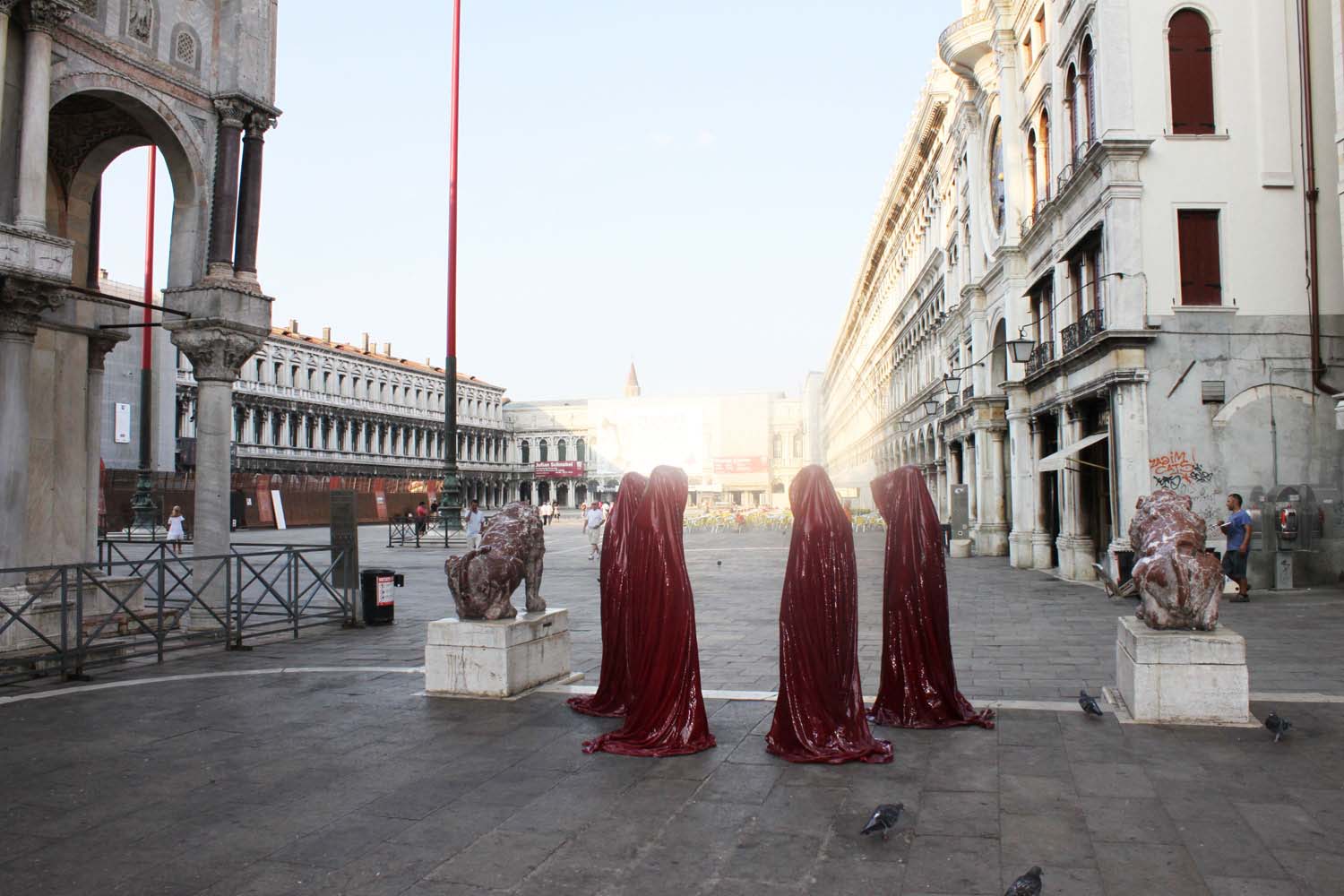
57th Venice Art Biennale
57th edition of the Venice Art Biennale opened to the public with managing editor Olivia Mull carefully selected best design-led exhibitions, spatial installations and pavilion takeovers. Artists, curators, architects, designers, musicians and refugees have all collaborated on works for this year's show. They range from architectural installations to spatial performances, covering topics embracing all aspects of life and society.
Here is what not to miss:


Venice is Sinking
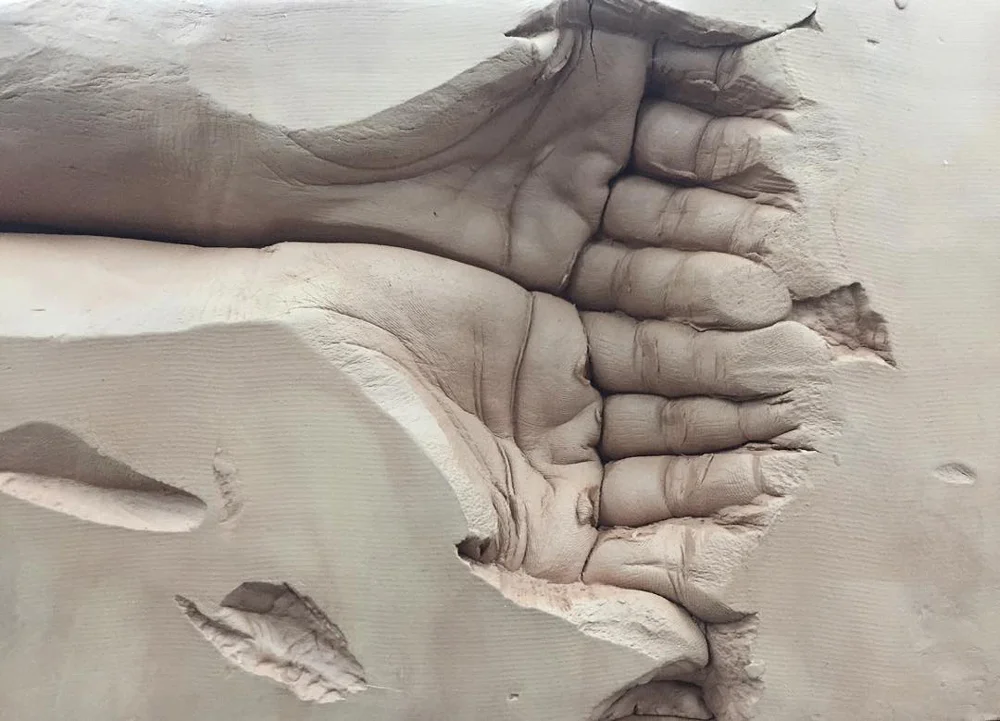
Italian artist Lorenzo Quinn calls attention to this threat with his arresting, larger-than-life sculpture in the sinking city. Support features two 5,000-pound hands bursting out of the Grand Canal and grasping the walls of the historic Ca' Sagredo Hotel.

Photograph by Maria Nitulescu, courtesy of the artist and the Georgian Pavilion
Living Dog Among Dead Lions by Vahjiko Chachkhiani Georgian Pavilion, Arsenale
A for of a small abandoned wooden hut, found in the Georgian countryside and reassembled by artist Vajiko Chachkhiani on-site. Furniture, pictures, lights and other household items are the only occupants of the cabin.
Chachkhiani has simulated a never-ending rainstorm inside the hut by puncturing the ceiling with hundreds of holes and installing an irrigation system above. Water puddles on the floor and furniture, and trickles through cracks in the wood. Visitors can watch the interior decay and rot over the course of the biennale, while the exterior of the house will remain untouched.

Photograph by Ruth Clark, courtesy of the artist, the British Council and Hauser & Wirth
Folly by Phyllida Barlow British Pavilion, Giardini
Clustered around the entrance of the neo-classical British Pavilian stand huge sculptures constructed from cardboard, paint, foam, plywood and concrete, metal stands. Created by 73-year-old British sculptor Phyllida Barlow, resembling architectural details or giant toys.

Photograph by Nadine Fraczkowski, courtesy of the artist and the German Pavilion
Faust by Anne Imhof German Pavilion, Giardini
Faust has been awarded this year's prestigious Golden Lion prize. It was described by the jury as "a powerful and disturbing installation that poses urgent questions about our time". Artist Anne Imhof has transformed the Nazi-era German Pavilion into a hostile stage set for her Faust exhibition. The Doberman dogs stand guard at the the front entrance. Raised glass floor inside, spans the white space and glass pedestals jut out from the walls. Groups of young performers dressed entirely in black sportswear occupy the space. They move emotionlessly amongst visitors to harsh metallic music – crawling under the glass floor, dragging their feet and bizarrely embracing.

Photograph by Prudence Cuming Associates, courtesy of Damien Hirst and Science Ltd. All rights reserved, DACS/SIAE 2017
Treasures from the Wreck of the Unbelievable by Damien Hirst Palazzo Grassi and Punta della Dogana
Rumored to be one of the most expensive exhibitions ever put by a contemporary artist and much-discussed exhibition is "all about what you want to believe.", comes from British artist Damien Hirst's Treasures. 16-metre barnacle-encrusted decapitated demon in the Palazzo's courtyard – were supposedly lost in a legendary shipwreck 2,000 years ago and rescued from the sea by the Turner Prize-winning artist.